

Along the rhythms of water: Imagining the Seine Metropolis
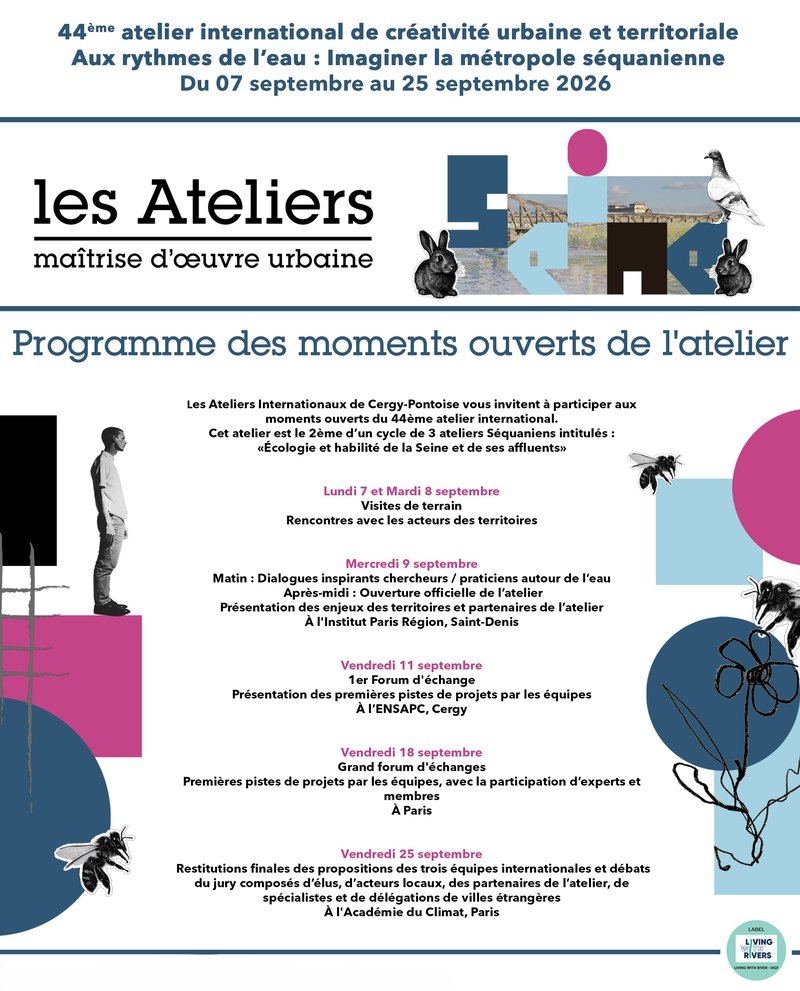
🌊 Here we go! | 44th International Workshop of Les Ateliers de Cergy
From 7 to 25 September 2026, Les Ateliers de Cergy are hosting their 44th international workshop: “Along the Rhythms of the Water: Imagining the Seine Metropolis.”
For three weeks, 15 participants from different countries and disciplines, working in three international and multidisciplinary teams, will explore the relationships between the metropolis, water and living systems.
The program includes field visits, meetings, debates, discussions and collective work, all contributing to an ambitious task: imagining a Seine metropolis that is more liveable, resilient and inclusive.
💧 Facing flood risks, droughts, urban overheating and growing pressure on soils and ecosystems, the workshop explores a shift from controlling water towards living with water and the ecosystems, while paying close attention to their cycles and dynamics.
Three weeks to observe, understand, debate and, above all, imagine together possible futures for the Seine basin.
📍 7–25 September 2026
🌊 Along the Rhythms of the Water: Imagining the Seine Metropolis
Living with water, a major challenge for the Greater Paris area and the Seine basin
At a time when ecological and social balances are becoming increasingly fragile - with pressures on resources, intensifying climate hazards, and widening inequalities - our ways of living are being profoundly questioned. Cities, with their legacy of development that has gradually distanced them from water, bear the brunt of these effects: channelled rivers, impermeable soils and altered environments. While this has fuelled their growth, it has also weakened ecosystems and increased vulnerabilities. Nowadays, it is not just a matter of controlling water; it is also about learning to live with it and adapting to its cycles and dynamics.
At the heart of these challenges lies the Paris metropolitan area, a territory that is both central and under strain. It is home to a large population and a variety of activities, networks and infrastructure, while facing growing vulnerabilities such as flood risks, urban heat islands, pressure on land and significant inequalities in access to resources and cool spaces. Water is omnipresent here, often invisible in the form of rivers, tributaries, aquifers and networks, yet it is fundamental to the territory’s balance. It is within this complexity, caught between the intensity of urban life and the fragility of environments, that our ability to imagine more sustainable and inclusive ways of living is now being tested.
The international workshop invites us to reconsider our relationship with water and its pathways, placing them at the heart of the Parisian metropolis as we address the fundamental question:
From management to coexistence: how can we rethink the city, based on its water and living environments, to make it more liveable, resilient and inclusive?
Participants will be invited to explore this question from several angles: how can we coexist with the Seine and its tributaries in dense urban areas that are increasingly at risk of flooding, drought and overheating? How can we integrate acts of care into the transformation of inhabited spaces to connect housing, uses, and living environments? What forms of governance and cooperation should we develop to anticipate conflicts of use and leverage water for transformation at the metropolitan level?
The 2026 session is part of the Sequanian workshop series, a collective reflection initiative on the future of the Seine basin, in a context of water scarcity, increased hydrological risks, and the need for new forms of territorial governance around water.
Participating in Les Ateliers offers a unique learning experience, combining direct engagement with local communities with a multidisciplinary, immersive approach. You will also embark on a meaningful human endeavour, filled with international encounters and collaborative work, and become part of an international network of participants and alumni.
documents
-
Along the rhythms of water - Session book
-
Teamwork: Living with European rivers
-
Along the rhythms of water - Context Document
-
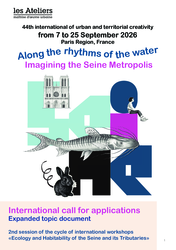
Imagining the Seine metropolis - Expanded call for applications
-
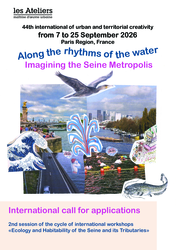
Imagining the Seine metropolis - Call for applications
-
Aux rythmes de l'eau - Cahier de session
-
Aux rythmes de l'eau - Dossier contexte
-
Imaginer la métropole séquanienne - Appel à candidatures détaillé
-
Imaginer la métropole séquanienne - Appel à candidatures
staff
The workshop team
Scientific pilots:
César Silva Urdaneta and Laura Châtaigner
Assistant-pilot: Clotilde Trivin
Director: Véronique Valenzuela
Director of projects: Simon Brochard
Management and communication: Victoire Bayle
Logistics and accounting: Lhakey Tenzin